HomeSolutionsBusinessFleet Tracking and Management
Operating layer · Solution
Fleet Tracking and Management
Live GPS, driver scoring, route playback, alerts and reporting for South African fleets. Multi-network coverage, integrated platform, one supplier.
- Smarter visibility
- Safer fleets
- Stronger operations
- Driver behaviour insights
- Smart alerts & reporting
- Easy-to-use dashboard
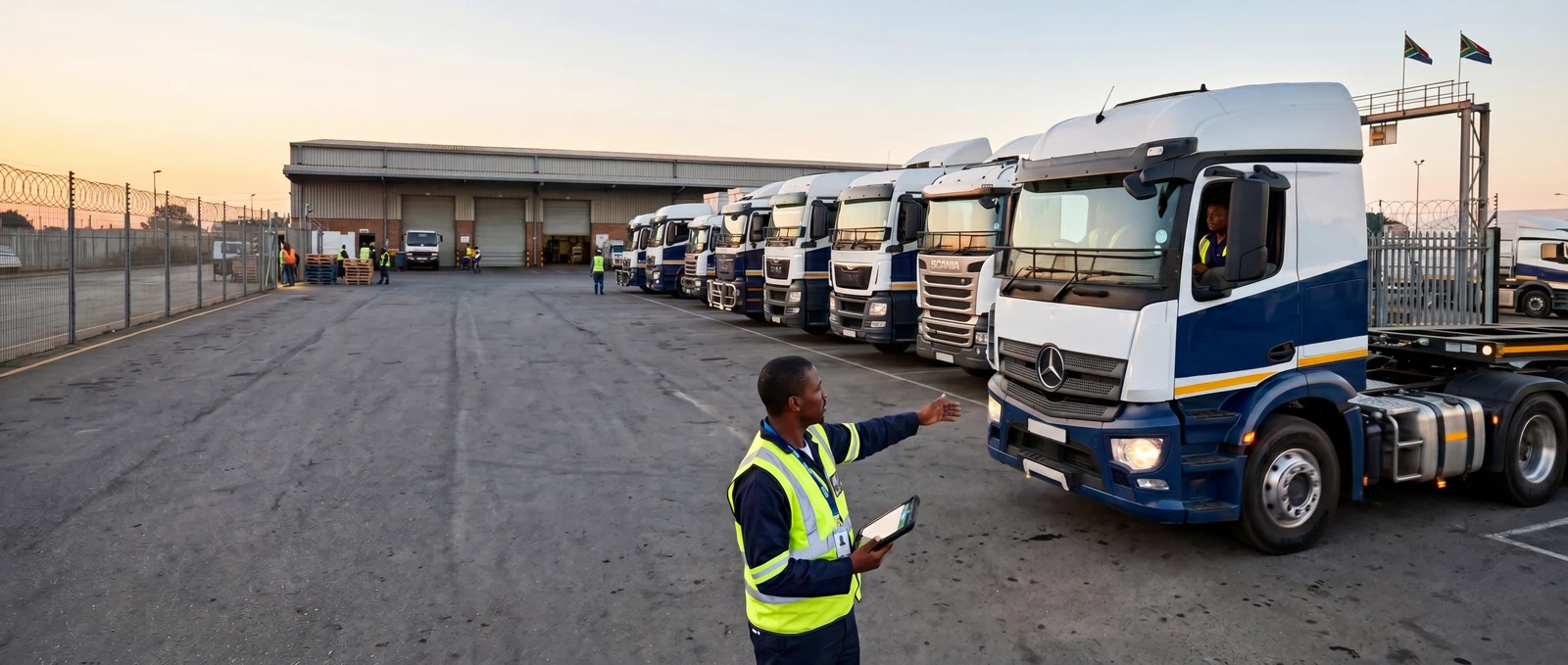
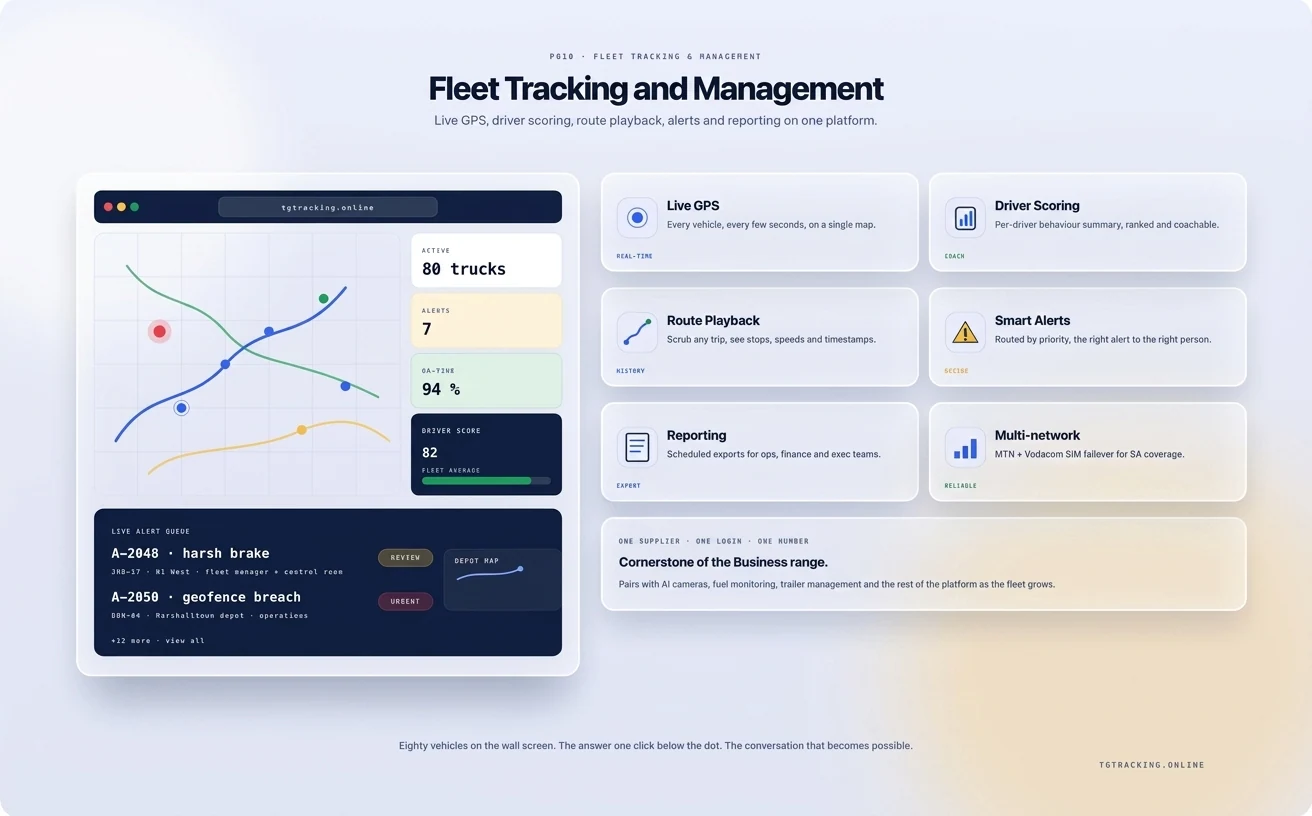
Live GPS, trip history and driver scoring on every fleet vehicle, on one platform with one login. The dispatch team in Spartan sees eighty vehicles on the wall screen with each one colour-coded by status, click any vehicle and the current trip, the driver, the previous stops and the planned route are on screen. When a customer calls about a delivery, the answer is one click below the dot rather than a callback in an hour. Fleet tracking turns the day's questions into shared facts the dispatcher, the driver and the customer can all see.
Direct answer
Fleet tracking and management from TG Tracking gives South African business fleets live GPS visibility, trip history with playback, driver scoring, geofences, alerts and reporting, all inside one platform on one login. It is the cornerstone of the Business solutions range and pairs with AI Camera Solutions, Fuel Monitoring, Trailer Management and the rest of the platform as the fleet grows. See Vehicle Tracking and Fleet Management for how cars and fleet vehicles share the same backbone.
What fleet tracking actually does for your operation
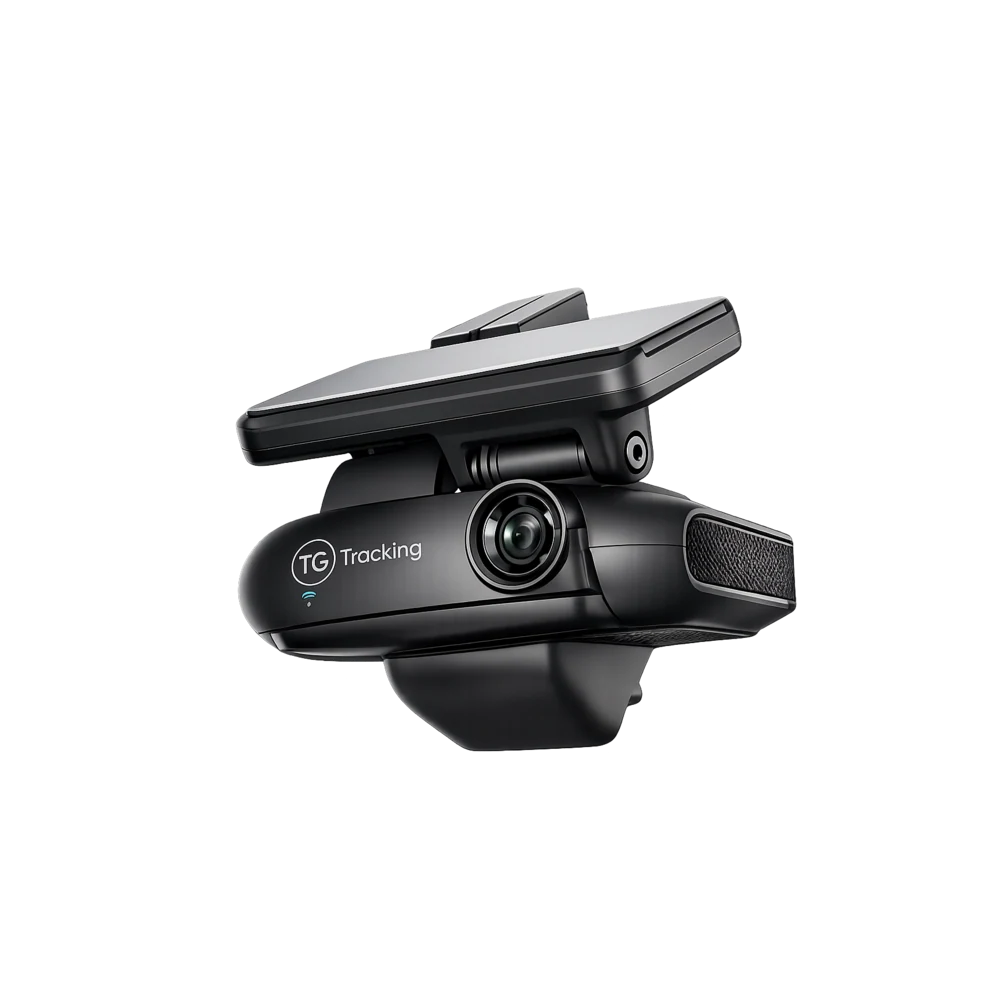
A hardwired tracking device sits in every fleet vehicle, draws power from the vehicle, and reports position, speed, ignition, sensor inputs and event flags every few seconds over a multi-network cellular SIM. The platform turns that stream into the answers a fleet manager actually needs: where the vehicle is right now, what it has done today, who is driving it, whether anything is unusual, and what the next action should be.
Live GPS and trip playback
Open TG Online and the entire fleet is on one map. Every vehicle is colour-coded by status: moving, stopped, idling, ignition off, alert raised. Click a vehicle and you see its current trip, its driver, its previous stops and its planned route. Open trip history and you replay any past route at variable speed with the timestamps, speeds and stops visible.
Driver scoring and behaviour insights
Harsh acceleration, harsh braking, harsh cornering, speeding events, idling and route deviation are all captured per driver per trip, not just per vehicle. Driver scorecards rank the fleet by safety and efficiency, isolate the small group that needs coaching, and feed into the AI camera coaching workflow if you carry that product too.
Alerts that move the operation, not just the inbox
Alerts are configurable per fleet, per vehicle and per driver. The events that matter for a Cape Town courier fleet are not the events that matter for a Limpopo agricultural operation, and the alert rules reflect that. Common alerts: unauthorised use, ignition outside operating hours, after-hours movement, geofence entry and exit, excessive idling, tamper detection, panic press, border crossing.
Reports that match how you actually run the business
Daily exception reports for the operations team, weekly utilisation summaries for the fleet controller, monthly cost-per-kilometre and fuel-efficiency reports for finance, ad-hoc route reconstructions for customer disputes. Schedule what you need, ignore what you do not, and feed the rest into Business Intelligence Dashboards when the fleet is ready for that layer.
Where fleet tracking pays back
The value is rarely in a single feature. It is in the chain that runs from data through alert through action.
Cost per kilometre
Every kilometre runs against a cost line: fuel burn, idle time, route adherence and operating hours. Fleet tracking puts all four on the same dashboard so the fleet manager has a per-driver, per-route view of how the operation is running. Pair this with Fuel Monitoring for a complete picture of where each litre goes.
On-time delivery and customer trust
Live ETAs, route exception alerts and trip history together close the gap between the customer's question and your answer. A delivery is late, the customer phones, the operations team sees the vehicle's position and the cause, and the customer gets a real answer in 60 seconds rather than a callback in 60 minutes.
Driver safety and risk reduction
Speeding, harsh events and seat-belt status feed the risk profile of every driver. Insurance assessors and HSE managers care about the trend line, not the snapshot. Fleet tracking provides the trend line. Add AI Camera Solutions for video evidence and ADAS road-hazard alerts.
Asset utilisation
Vehicles that sit unused for three days a week are vehicles you are paying for and not earning from. Utilisation reporting flags the under-used vehicles, the over-used vehicles and the depots where the rebalancing has to happen.
Industries this is built for
The platform is industry-agnostic at the data layer and industry-configured at the alert and reporting layer.
Transport and logistics
Long-haul trucking on the N3, N1 and N4. Intercity courier and parcel networks. Cross-border operations into SADC. Reefer trailer integration through Trailer Management and Temperature and Cold Chain Monitoring.
Construction and plant hire
Site-to-site movement of bakkies, water tankers, plant equipment and operator vehicles. Pair with Wireless asset tracking for non-powered plant.
Field services and trades
Service vans, electricians, plumbers, HVAC technicians, fibre install crews. Routing, on-site dwell time, callout efficiency and tools-of-trade tracking.
Agriculture, rental and public sector
Farm fleets running between fields and depots. Rental fleets with mixed-use cycles. Municipal vehicles, security companies, emergency services. Each has its own configuration; the underlying platform is the same.
For the full industry list, see Industries we serve.
Why TG Tracking for South African fleets
A fleet platform built for German motorways is not a fleet platform built for the N1 between Beaufort West and Bloemfontein in winter. The cellular layer needs to switch networks where one operator drops out and another picks up. The hardware needs to survive Highveld hailstorms, Karoo summers and Free State dust. The control room needs to speak to South African recovery partners and SAPS, not a global call centre. The platform needs to keep working when the network is slow, the depot is on a generator, and load-shedding has dropped a regional tower for two hours. We design for those conditions by default, not as an afterthought.
The team you call is in this country. The hardware ships from this country. The support queue is staffed in this country. One supplier, one number, one invoice for the entire stack. See Operations and workflow for the layer that sits on top of fleet tracking and turns the data into the daily routine your dispatch team actually runs.
Frequently asked questions
How many vehicles do I need to make TG Tracking worth it?
There is no minimum. We have customers running a single business vehicle and customers running thousands. Pricing is per device per month with package discounts that scale with fleet size. See Pricing or book a demo for a quote against your specific fleet shape.
Does it integrate with our TMS, ERP or dispatch system?
Yes. The platform supports common South African and international fleet, logistics, ERP and HR integrations through documented APIs and webhooks. Specific integrations are scoped during onboarding so the data flows match your existing process rather than asking you to change it.
How does multi-network failover actually work?
The SIM in each device can connect to multiple South African cellular networks. If the primary network drops or has poor signal, the device switches to the next available network without manual intervention. Coverage is best on routes where multiple operators have rolled out and slightly weaker on remote rural sections. We will tell you upfront where a route is likely to have gaps.
Can drivers turn the device off?
The device is hardwired and tamper-protected. Disconnection raises an alert immediately. Drivers cannot mute the platform without it being logged.
Will my insurer give me a fleet premium discount for it?
Most major South African insurers and underwriters offer some form of fleet discount for telematics-equipped fleets. The size of the discount depends on the insurer, the fleet profile and the level of telematics integration. Confirm with your broker.
How do we move from our current provider to TG Tracking?
Onboarding handles the migration: hardware swap on a vehicle-by-vehicle schedule, account migration, geofence import, driver list import, reporting handover and integration retrofit. The pace is set by your operation, not by us.
What does the fleet manager see day to day?
A live map, today's exception list, top-five risk drivers, top-five fuel anomalies, the maintenance schedule, and any open alerts. Custom dashboards layer in the KPIs your specific business runs on. See Business Intelligence Dashboards.
Talk to our fleet team
If you have read this page, you have likely outgrown a single tracker dashboard or a multi-vendor stack. Book a demo and a specialist will walk you through the platform with your fleet shape in mind.
Recommended hardware
The right tracking layer for fleet tracking and management.
Vehicle, asset, driver and reporting hardware tuned to the way real businesses run fleets.

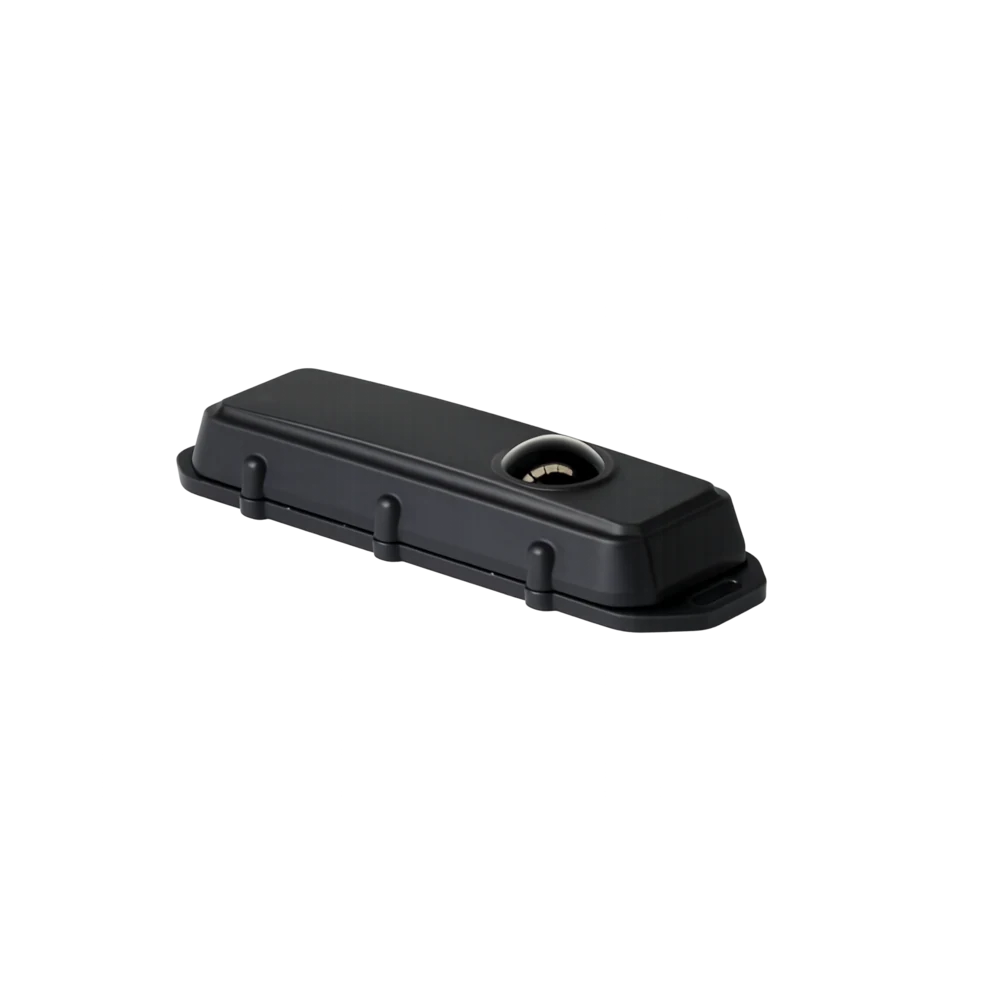
BARRA-RADAR-BLE · Wireless trackers
Barra Radar BLE
Object and Level Detection via Radar Bluetooth device in Barra form-factor (batteries not included)
IN STOCK · ZAR
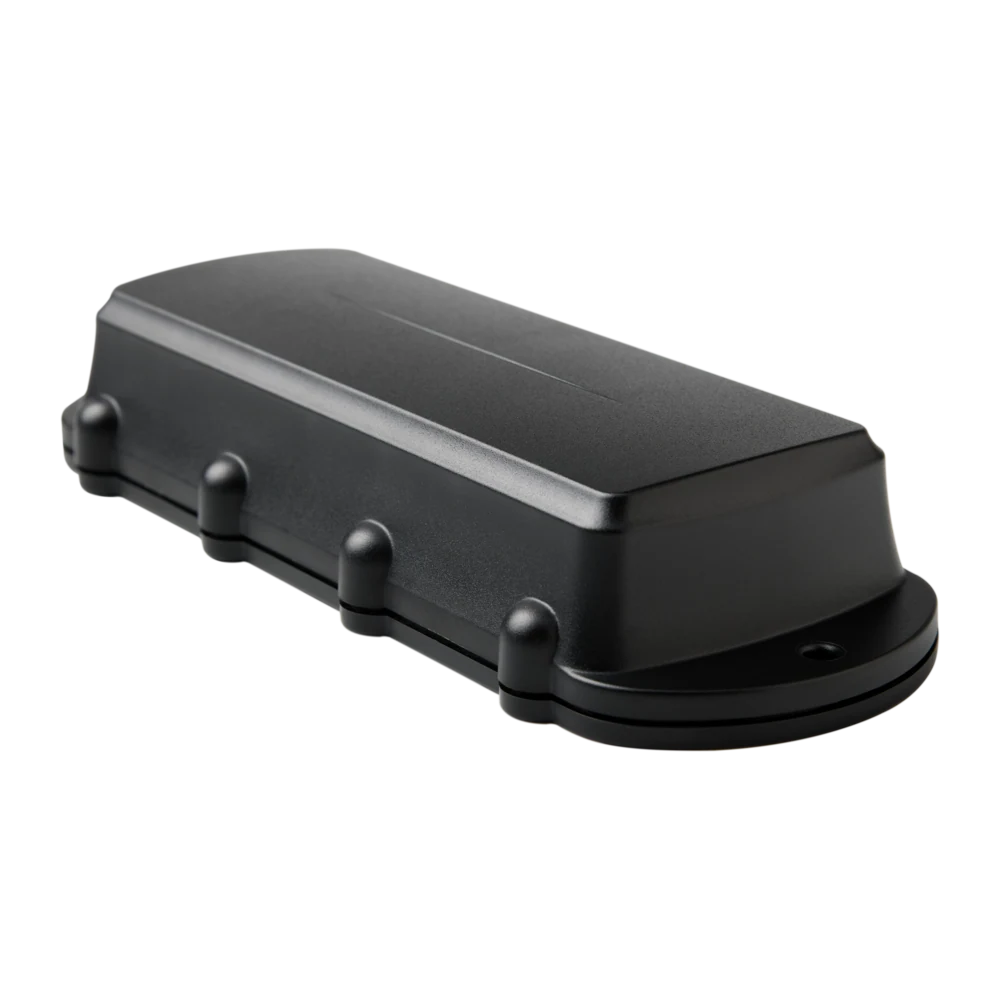
REMORA3-GLOBAL · Wireless trackers
Remora3 Global
Remora3 Global GPS tracker on 4G Cat1bis with 2G fallback, Bluetooth 5.2 gateway
IN STOCK · ZAR
More in Business
Business overview
Related business solutions.
Talk to TG Tracking
Add Fleet Tracking and Management to your fleet operating layer.
Tell us what you run, where you run it and the risk profile. We'll match the hardware, platform and rollout plan to your operation.