HomeSolutionsSafety, Compliance & RiskDMS
Operating layer · Solution
DMS
AI in-cab driver monitoring for South African fleets. Fatigue, distraction, phone use and seatbelt detection with cab voice prompts and audit logs on TG Tracking.
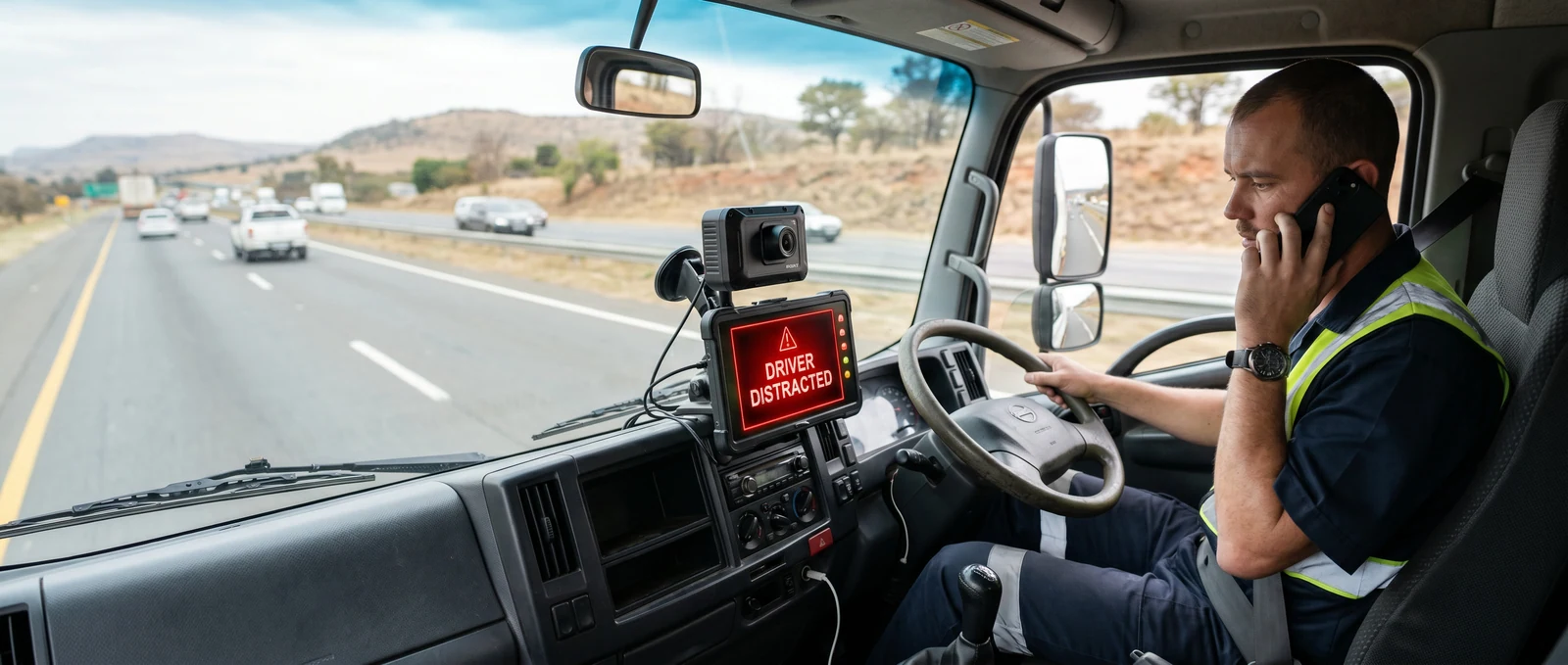
A 03:40 night-haul leg between Bloemfontein and Colesberg on the N1. The driver has been on shift for six hours, the cab is warm, the road is straight. Over a two-minute window, the eye-closure rate climbs from a baseline pattern to a sustained drowsy state, the head pose tilts forward, two yawns inside ninety seconds. Yesterday this is the moment the truck drifts onto the verge. Tonight the in-cab DMS reads the pattern, fires an audible fatigue prompt, and the driver pulls in at the next safe stop. DMS is the in-cab system that flags fatigue before it becomes an accident.
Direct answer
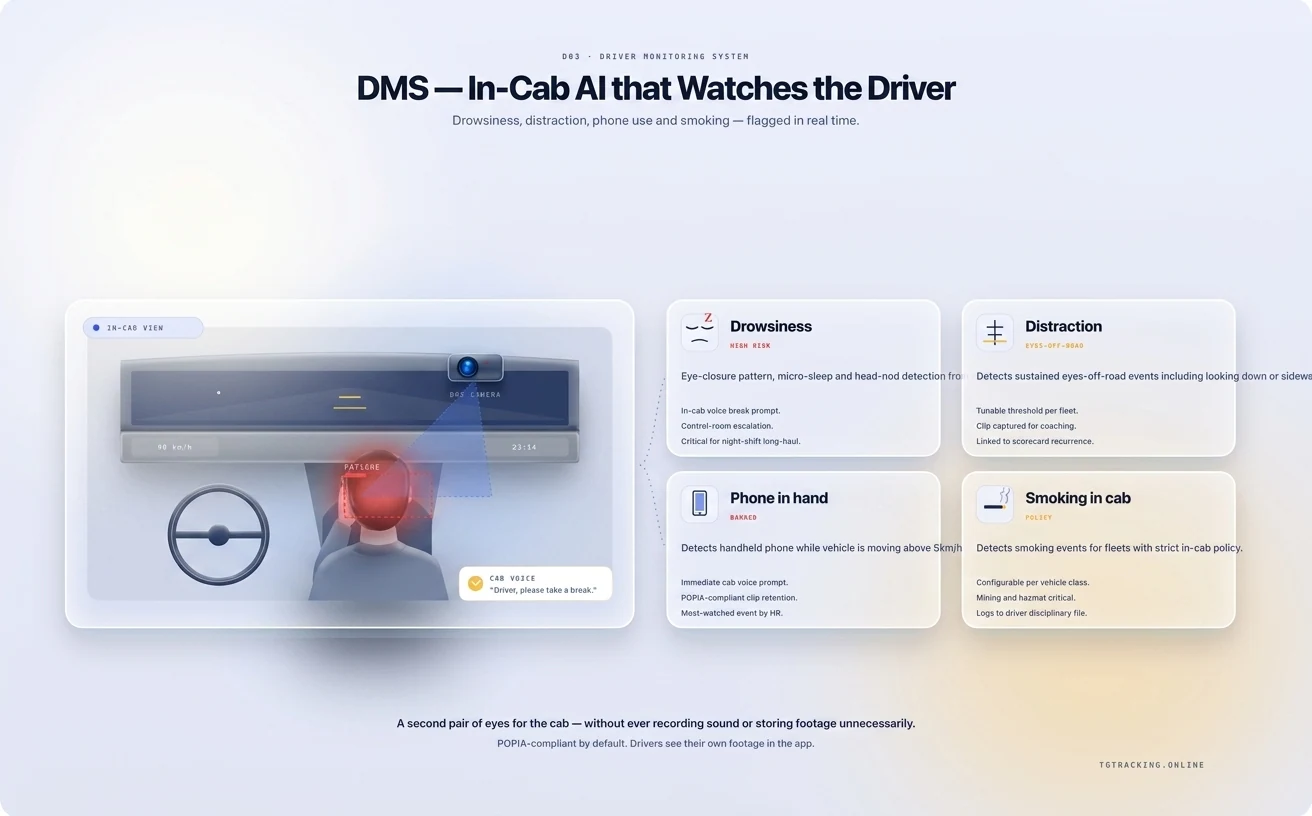
TG Tracking DMS is the AI in-cab driver-monitoring system inside the Fleet Safety, Compliance and Risk cluster. It detects fatigue, distraction, phone use, smoking, eating, seatbelt status and head pose, with cab voice prompts and event clips uploaded to TG Online. It pairs with ADAS for the road-ahead side, AI Fleet Dash Cameras for cab and road event capture, and feeds Driver Coaching and Behaviour Insights. DMS is POPIA-sensitive: in-cab biometric processing requires a lawful processing posture, audit logging, retention policy and Information Officer attestation.
What DMS reads inside the cab
DMS is computer vision focused on the driver's face, head and visible behaviours.
Fatigue and drowsiness
Eye-closure rate over a sustained window, head-droop pattern, yawn frequency, slow blink rate. The cab speaker fires an audible warning when the pattern crosses the threshold. The point is the warning before the micro-sleep.
Distraction
Eyes off road over a sustained window, looking down to lap, looking sideways during the trip, reaching behind. The cab prompt corrects most events in the same trip.
Phone use
Phone in hand, phone-to-ear, texting and browsing patterns flagged in real time. Phone use is the single most common AI flag and the easiest to coach.
Smoking, eating, seatbelt and head pose
Smoking and eating events get coaching markers rather than disciplinary triggers; recurrence matters more than the single event. Seatbelt status is a continuous check while ignition is on. Head pose builds a per-driver forward-focus baseline so sustained inattention is flagged even when the eyes are open.
Why this page is POPIA-sensitive
DMS processes the driver's face and behaviour, which under POPIA constitutes special-category personal information. The deployment posture matters: lawful workplace processing under operating-condition tests, role-based access on TG Online, audit logging on every retrieval, a defined retention period, encryption in transit and at rest, and Information Officer attestation. Driver consent posture under BCEA, LRA and EEA needs review with your HR or labour-law advisor before rollout.
How DMS pairs with ADAS
ADAS warns about the road; DMS warns about the driver. A drowsy driver gets a DMS alert; the same driver drifting out of lane gets an ADAS lane-departure warning. The cab voice prompt is the first coach. The Driver Coaching and Behaviour Insights workflow is the second.
South African night-haul realities
Long-haul night legs concentrate fatigue risk on specific corridors. Bloemfontein to Colesberg between 02:00 and 04:00, the Van Reenen's Pass descent at dawn, the Karoo stretches between Beaufort West and Three Sisters in the small hours, the N4 to the border in the dark mornings. The DMS catches the pattern before the driver does. For mining-house compliance the fatigue-detection record forms part of the safety committee evidence pack alongside Mining IVMS.
Frequently asked questions
Is DMS legal under POPIA in commercial fleets?
DMS can be deployed lawfully under POPIA with the right posture: workplace processing under operating-condition tests, role-based access, audit logging, retention policy and Information Officer attestation. Specific deployment depends on your operation.
How accurate is fatigue detection?
The detection works on a combination of eye-closure, head pose, yawn and blink-rate patterns calibrated per driver. Specific accuracy figures are operational and not published as marketing claims; we share them under NDA with fleets evaluating the system.
What happens to the cabin video?
Video is recorded locally on the device for trip review and uploaded to the cloud only on a triggered event or an explicit retrieval. Footage access is role-based on TG Online and audit-logged. Retention is configured during onboarding.
How do drivers respond to DMS in the cab?
Most drivers settle in inside the first month when the system is positioned as protective rather than punitive. The cab voice prompt corrects most events in the same trip. Hostility usually traces to how the rollout is framed. The first month sets the tone.
Will my insurer recognise DMS at renewal?
Insurer recognition of in-cab DMS is rising, particularly when paired with ADAS and a coaching workflow. Confirm with your broker.
How is DMS different from AI Fleet Dash Cameras?
AI Fleet Dash Cameras is the in-cab event camera with both road and cab AI on a shared hardware family. DMS is the focused in-cab driver-monitoring layer with biometric event detection and the POPIA-specific deployment posture.
Can DMS data trigger a disciplinary process?
DMS data can support a disciplinary process if your HR or labour-law advisor designs a defensible policy. The platform writes dated, signed coaching logs; the disciplinary process around them is yours to design under BCEA, LRA and EEA.
Protect your drivers
If your fleet runs night legs, long-haul or fatigue-prone corridors, DMS is the layer that catches the pattern before the driver does. Book a session and we will walk you through a real DMS event and the POPIA rollout pack.
Recommended hardware
The right tracking layer for dms.
AI-camera, ADAS and DMS technology with vehicle telemetry that surfaces driver behaviour and incident events.
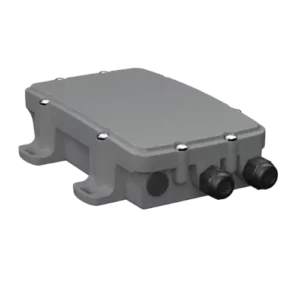
G150-GLOBAL · Wired trackers
G150 Global
G150 Global GPS tracker on Cat1bis and 2G, rugged IP68, Bluetooth 5.2 gateway, 1 harness
IN STOCK · ZAR
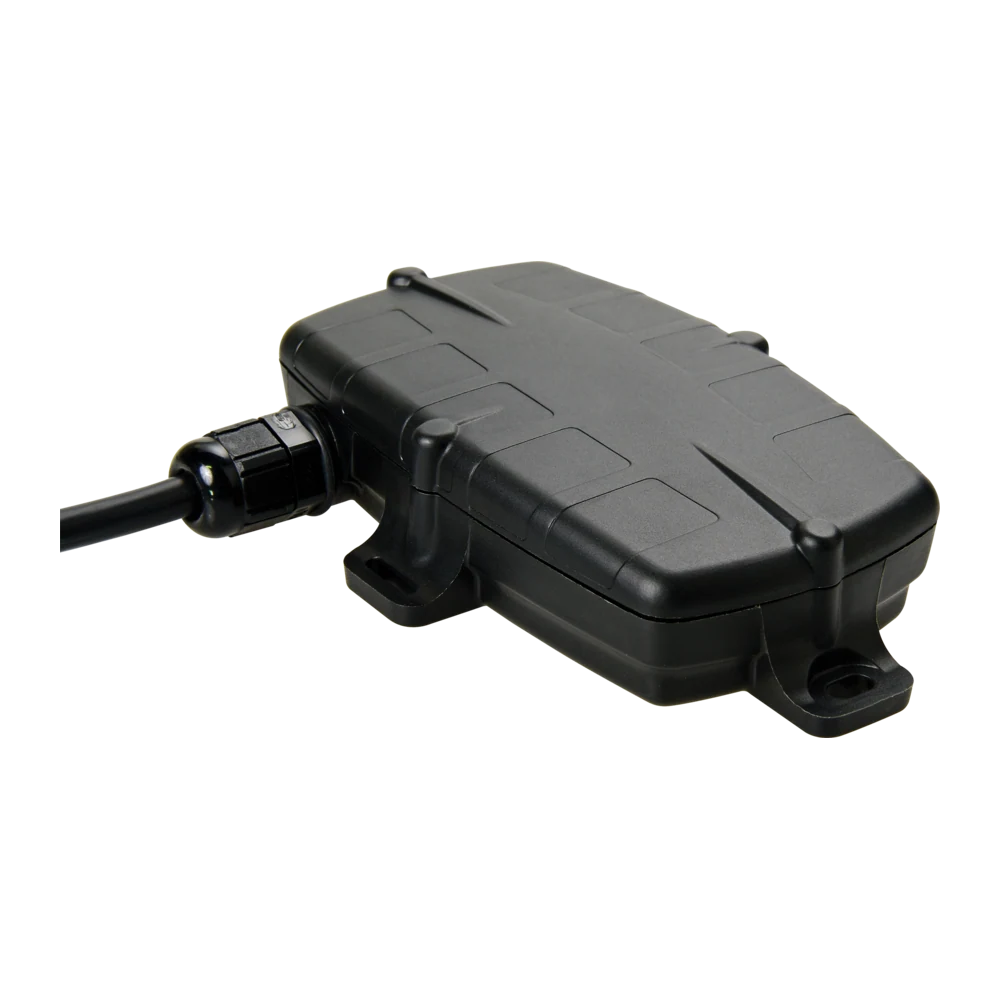
G70-4G-BLE · Wired trackers
G70 4G BLE
G70 GPS tracker with Bluetooth, 4G LTE-M / NB-IoT, rugged IP68, multiple IO’s
IN STOCK · ZAR
More in Safety, Compliance & Risk
Safety, Compliance & Risk overview
Related safety, compliance & risk solutions.
Talk to TG Tracking
Add DMS to your fleet operating layer.
Tell us what you run, where you run it and the risk profile. We'll match the hardware, platform and rollout plan to your operation.